Meeting Jim

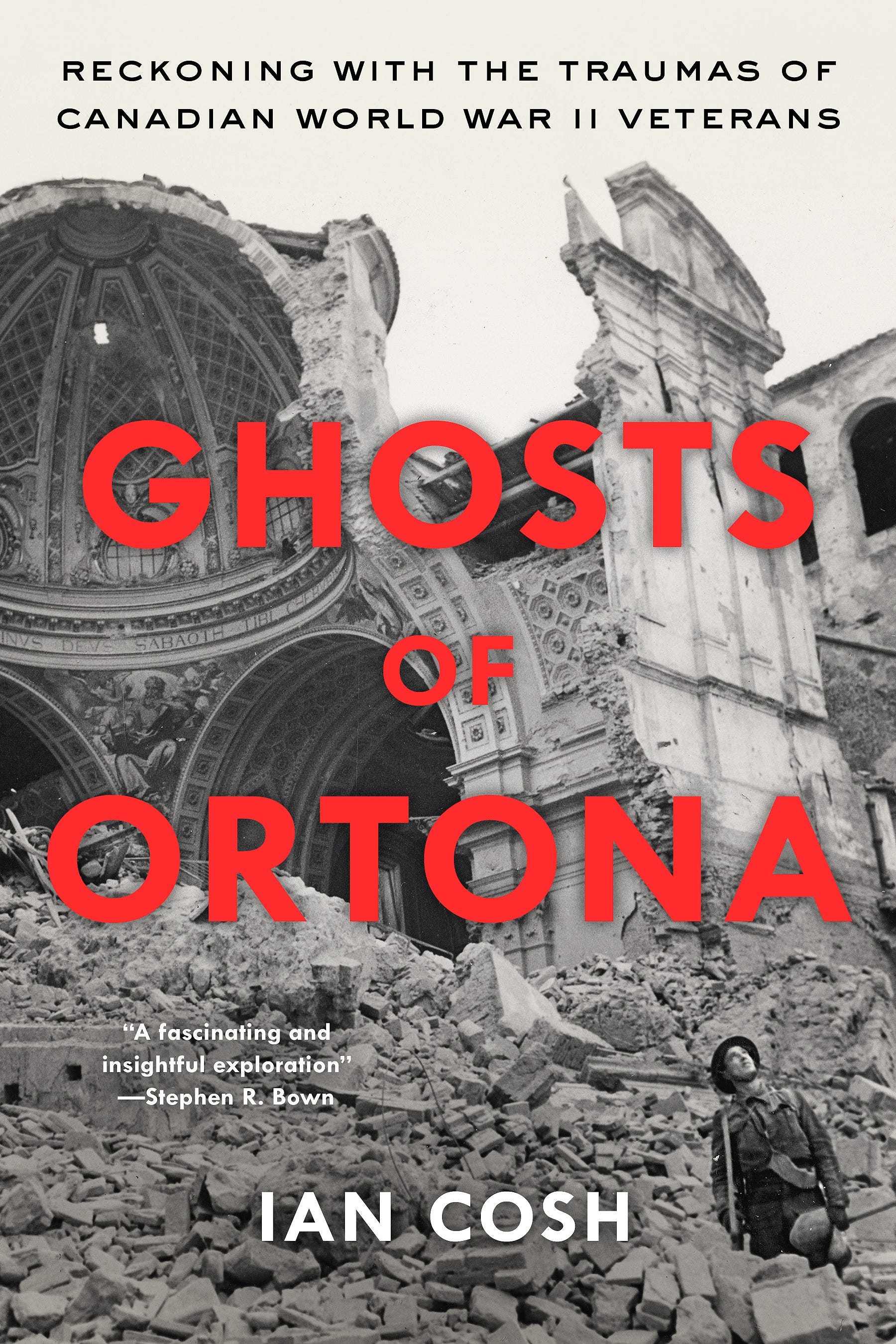
An excerpt from Ghosts of Ortona: Reckoning with the Traumas of Canadian World War II Veterans.
I remember the sound of the wipers on the windshield of Sam’s car. We were driving up the northern highway in the early winter darkness. The road was wet from gently falling snow. Huge trucks blew spray onto our windshield as they thundered past, hauling loads of gigantic logs. Somewhere to the north, forests of massive trees were being harvested. Here, where we were driving, there were just a few plots of woods among the low barren hills. In the distance I could see the silhouette of a working pumpjack and the light of a gas flare.
We stopped at a gas station. While filling the tank, Sam remembered that he had a friend nearby who’d been a sniper in Ortona. He said this would be a good guy for me to meet. If I didn’t mind delaying our dinner at the restaurant, maybe he’d call the guy and ask if we could drop in. I said sure, let’s do it. Sam went to use the payphone and came back with the word that we were invited over right away.
A dirt road took us into an evergreen forest where the branches were laden with snow. The trees cleared briefly when the road crossed some train tracks, and then came thick around us again. We arrived at a clearing where there was a little wooden house with smoke rising from its chimney. It had a brightly lit window, and a brightly lit doorway that was open with a man standing in it. We got out of the car and Sam said some words of greeting. His friend Jim answered with a muttered word and a nod.
Jim was short and stocky with baggy eyes and a gruff, grey-whiskered face. He was in a plaid shirt, cardigan with holes in it, loose jeans, and puffy slippers—quite a contrast to Sam, who was skinny and extra clean-cut after shaving, combing his hair, and dressing up for the restaurant. When I started to remove my boots at the door, Jim brusquely grumbled that he didn’t follow that “stupid rule”—I should leave my boots on.
We went to the Formica kitchen table where there was a choice of mismatching chairs. I started to take an old wooden one, but Jim pushed a chair on wheels my way, saying this would be more comfortable. On the table stood three mugs with images of Alberta and the Calgary Olympics, and an ashtray. Sam started introducing me, saying that I was a student from Toronto. Jim shuffled to the stove, came back with a steaming pot, poured oily black tea into the mugs, and sat down with a cigarette, all while listening to Sam telling him about our work on Sam’s war souvenirs. The refrigerator was humming. A bulletin board on the wall had pinned to it a drugstore calendar, receipts, handwritten notes, and a war remembrance red poppy. I took my tape recorder from my bag and started to say my usual words to introduce my research.
Suddenly Jim was staring at me, panic-stricken.
“I can’t talk about those things,” he gasped.
He turned to Sam. “I can’t talk about those things.”
He turned back to me. “I’m sorry.”
I said it was fine, no problem. Hurriedly, I tucked my recorder back into my bag. This was awkward. It had happened so quickly. I had assumed that, in his phone call, Sam had told Jim about my research and Jim had agreed to be interviewed. Stupid of me. Poor Jim had been caught completely unawares.
Sam didn’t seem the least bit troubled.
“Well,” he said, “it’s easier to remember the good times.”
And then Sam carried right on talking about the war.
I wanted to tell Sam that this really wasn’t necessary. Jim was staring at him helplessly. His cigarette hand was shaking. I was wishing that Sam would stop.
Sam asked Jim if he remembered the women in England. “It was amazing,” Sam said. “All they wanted to do was get married.” Jim nodded. Sam continued. “I told some of the girls that I owned a gopher farm back in Alberta. And goddamn it, they believed me!” Jim grinned and took an unsteady puff of his cigarette.
Sam asked Jim if he remembered going through that town in Italy where they’d seen the cathouse. Later, when they got some time off, some of the guys had gone back to it. “They just walked in the cathouse door and right away they were grabbed by the MPs [military police] who had been there waitin’ for them!” Jim nodded, grinned, and muttered. “Yeah, those MPs, they knew someone would be tryin’ that.”
I had been silent all this time after giving that fright to Jim. Now I spoke up.
“Sorry, what—what’s a cathouse?”
Sam and Jim both froze, looking at me. Maybe they’d forgotten I was there.
Then they erupted in laughter.
“That’s another word for a whorehouse,” Sam said.
Jim was cackling, his whole body shaking. He wiped tears from his eyes.
Sam continued with the funny stories, asking Jim, did he remember this, did he remember that. Jim relaxed with his elbows on the table, grunting, grinning, nodding along. Did Jim remember the old Italian asking them if they knew Joe DiMaggio. Did Jim remember stepping in shit from the donkey trains. Did Jim remember the sergeant liberating wine and chickens from the farms. Yep, yep, Jim muttered, puffing on his cigarette, tapping out the ashes.
Sam asked, “Do you remember landing in Sicily and jumping into six feet of water?” Jim nodded vigorously. Sam went on. “And we had those goddamn heavy packs on our backs.”
Sam turned to me. “You see how short Jim is. Can you imagine?”
Jim muttered something about the guy next to him telling him to put his arm around his shoulder, the guy helping him to keep his head above the water.
Sam said, “I remember this big Scottish sergeant, when I went under, he grabbed me and he pulled me along, and he was yelling, ‘Come on, Canada, you can make it!’”
Jim cackled again, shaking with laughter, but his face was turning red in a grimace. His lip quivered. A tear streamed down his cheek. He stubbed his cigarette and wiped his wet eyes with his calloused hand.
Sam went on remembering this, remembering that, while Jim listened and agreed. Then the house began to vibrate. Through the forest outside came a slow thumping mechanical sound. It was the approach of a freight train. The noise grew louder and louder, to the point that I felt the train was going right through us. The little house reverberated to the rhythmic squeaks and bangs. Sam continued talking as if nothing were happening. I could barely make out his words.
Gradually the sounds of the train receded. The house became very still. Sam paused at the end of a story.
“Well,” he said.
He sat up straight. It was time for us to be going.
Snow crunched under our feet as we walked outside to the car. Sam stopped in front of a tree and took a long, loud piss on its trunk. I looked up. The snow had stopped falling. It was a clear, moonless, starry night. I could smell the smoke from the wood burning in Jim’s stove.
We got into Sam’s car. As he put it in reverse, Sam said to me, “I’m sorry that wasn’t very useful.”
In the window of Jim’s house, brightly lit, I saw the whiskered face watching our departure. Then the face, window, and house disappeared behind trees as we turned onto the road. I said no, no, it was useful. It was good to meet Jim, interesting to hear the stories.
We drove across the train tracks and down the dirt road. “Jim drank a lot after the war,” Sam said, “and it affected his memory. He was a sniper, so he saw a lot of the action. But he lost his memory from drinking.”
That got Sam onto the topic of his own methods for remembering— “See, I never drank. This is how I can remember in such good detail”—as he steered the car onto the paved highway and started us back on our way.
But I was thinking about something else as I got my recorder back out to resume taping. I was thinking that Jim’s problem with memory was not really that he had lost it.
For more about Ghosts of Ortona, including where to find the book, please see my website.
If you’d like to be notified when I publish something new, and to hear occasionally about talks and other developments related to my work, I’d be glad to have you subscribe.